Facial thirds are a simple way to assess vertical facial balance. The method divides the face into three horizontal sections: from the hairline to the brow area, from the brows to the base of the nose, and from the base of the nose to the chin. Learning how to check facial thirds can help you evaluate facial proportions for makeup placement, hairstyle choices, orthodontic discussions, aesthetic consultations, portrait drawing, or simple personal curiosity.
The goal is not to decide whether a face is “good” or “bad.” Human faces naturally vary, and even faces widely considered attractive rarely follow textbook measurements exactly. Facial thirds are best treated as a reference framework rather than a beauty rule. In this article, you will learn where to find the correct landmarks, how to measure your own facial thirds accurately, what uneven thirds may mean, and when factors such as hairline changes, posture, camera angles, and dental structure can affect the result.
What Facial Thirds Mean
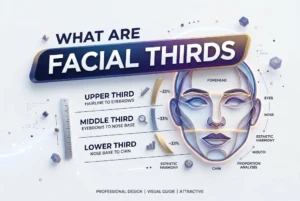
Facial thirds describe the vertical relationship between three areas of the face. In classical facial analysis, the upper, middle, and lower thirds are ideally close in height. This proportional concept appears in art, cosmetic assessment, orthodontics, and facial plastic surgery because it gives professionals a shared way to discuss facial balance.
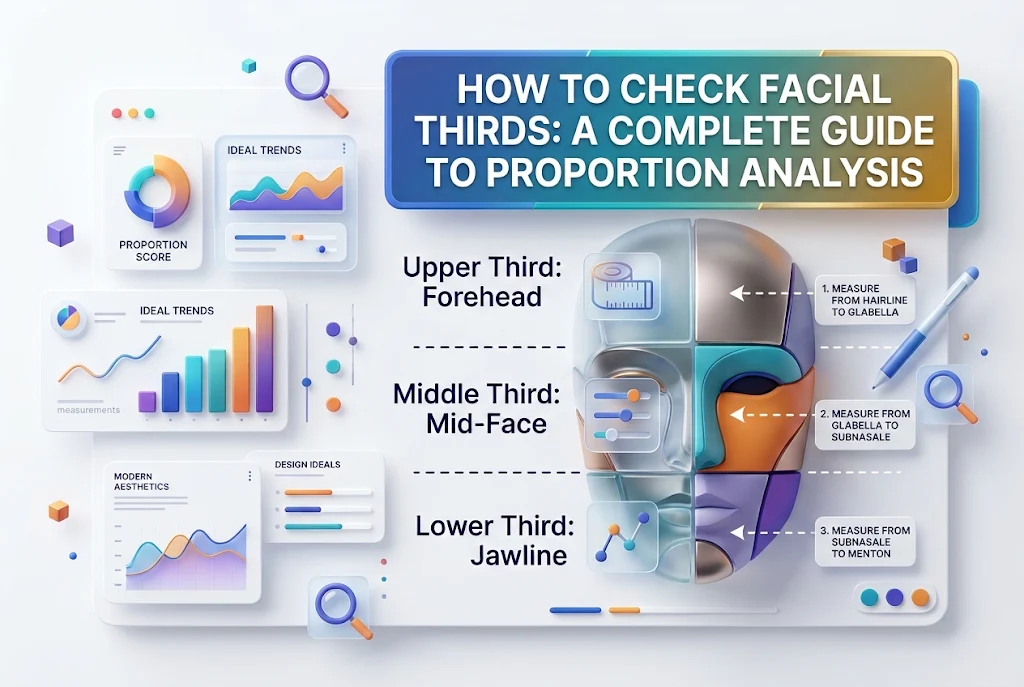
The upper third runs from the hairline to the glabella, the smooth point between the eyebrows. The middle third extends from the glabella to the subnasale, where the bottom of the nose meets the upper lip. The lower third continues from the subnasale to the lowest point of the chin.
Equal measurements are not a requirement for a balanced-looking face. Genetics, ethnicity, age, sex, bone structure, soft tissue, and personal expression all influence facial proportions. A slight difference between sections is common and often unnoticeable in everyday life.
Facial thirds should also be viewed alongside width, symmetry, profile, lip position, and chin projection. Measuring only vertical thirds gives you one useful piece of the larger facial-proportion picture, not a final assessment of appearance.
The Landmarks You Need to Find
Accurate facial-third measurements depend on using consistent landmarks. Before reaching for a ruler or taking a photo, locate these points gently in a mirror. Do not stretch your skin, raise your brows, or tilt your head to make the points easier to see.
The first landmark is the trichion, commonly called the hairline point. It is the midpoint where the central forehead hairline begins. The second is the glabella, located between the eyebrows and slightly above the bridge of the nose. The third is the subnasale, the crease at the base of the nose.
The final landmark is the menton, the lowest point on the soft-tissue chin when your mouth is closed normally. It is not necessarily the point that projects furthest forward. For a home check, use the point that appears lowest when facing the mirror straight on.
Key landmarks for a facial-thirds check:
- Hairline midpoint or trichion
- Brow-level glabella
- Base of the nose or subnasale
- Lowest visible point of the chin or menton
Preparing for an Accurate Home Measurement
A mirror measurement can be useful, but a straight-on photo often makes comparison easier. Use natural, even lighting and stand at a comfortable distance from the camera. A phone held too close can distort the center of the face and make the nose, midface, or chin look larger than it is.
Keep your head upright in a relaxed natural position. Your eyes should look forward, your teeth should rest together lightly or remain in your normal bite, and your lips should be relaxed. Avoid a forced smile, pursed lips, raised eyebrows, or a jutting chin.
Pull hair back if it hides the center of your hairline. If you have bangs, a receding hairline, hair loss, or a naturally irregular hairline, record that limitation before interpreting the upper third. The hairline is one of the least stable landmarks because it can shift with age and hair changes.
For the clearest reference image, place the camera at approximately eye level and use a neutral focal length. A rear camera positioned farther away with slight zoom is generally more reliable than a close selfie.
How to Check Facial Thirds Step by Step
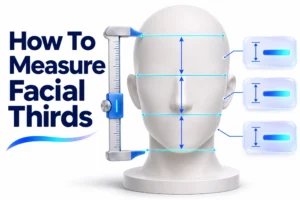
You can check facial thirds with a flexible tape measure, a ruler held near the face without pressing into the skin, a facial-analysis app, or a photo-editing tool. The simplest method is to use a front-facing photograph and mark landmarks digitally.
1. Take a level, straight-on photo in good light. Keep your face neutral and make sure the full hairline and chin are visible.
2. Mark the center hairline, glabella, base of the nose, and lowest point of the chin. Use a photo markup tool so you can zoom in without guessing.
3. Measure the vertical distance from hairline to glabella. This is your upper third.
4. Measure from glabella to the base of the nose. This is your middle third.
5. Measure from the base of the nose to the bottom of the chin. This is your lower third.
6. Compare the three measurements. You can use millimeters, pixels, or any consistent unit. The units matter less than using the same scale for each section.
7. Note noticeable differences without assuming they are problems. A facial third that differs by a few millimeters may be normal, especially in a photo.
For example, measurements of 58 mm, 61 mm, and 63 mm show three relatively close sections. Measurements of 45 mm, 63 mm, and 70 mm indicate more visible variation, but they still do not explain why the differences exist or whether any treatment is appropriate.
Measuring the Lower Third More Closely
The lower third often receives extra attention because it includes the lips, teeth, jaw, and chin. It can be divided into two smaller portions: from the base of the nose to the lip separation, and from the lip separation to the bottom of the chin. Classical references often describe the lower portion as roughly twice the height of the upper portion.
That ratio is a guideline, not a fixed standard. Lip thickness, lip posture, tooth display, chin soft tissue, and age can change what you see. Someone with fuller lips, for example, may appear to have a different lower-third relationship even when their skeletal proportions are typical.
Your bite also matters. Measure with your teeth in their natural closed position, not with the jaw clenched tightly or held apart. An overbite, open bite, missing teeth, or jaw positioning issue can affect lower facial height and should be assessed by a qualified dental or orthodontic professional if it causes functional concerns.
Common home-check mistakes include:
- Measuring a close-up selfie taken with a wide-angle lens
- Using the top of the eyebrows instead of the glabella
- Choosing the nostril edge instead of the base-of-nose crease
- Measuring while smiling or raising the eyebrows
- Treating an uneven hairline as a precise anatomical landmark
- Assuming equal thirds are necessary for attractiveness
- Comparing your measurement to edited or filtered online photos
What Uneven Facial Thirds Can Indicate
A longer upper third may reflect a naturally high hairline, a long forehead, or hairline recession. It does not automatically mean the forehead is disproportionate. Hairstyle, hair density, and eyebrow placement can strongly change how long the upper face appears.
A longer middle third may relate to nasal length, midface bone structure, or the distance between the brows and nasal base. In photographs, lighting and the angle of the nose can make this area appear longer or shorter than it does in person.
A longer lower third may result from chin height, jaw position, tooth eruption patterns, dental bite relationships, or simply inherited facial shape. A shorter lower third can be associated with a retruded chin, tooth wear, reduced vertical dimension, or soft-tissue fullness, though a measurement alone cannot diagnose any of these factors.
Facial balance is often perceived through contrast rather than isolated numbers. A strong chin may make the lower third seem longer, while a fuller hairstyle can make the upper third appear shorter. This is why professional assessments combine measurements with direct examination and profile analysis.
Factors That Can Change the Appearance of Facial Thirds
Your facial thirds are not visually fixed in every context. Hairstyle, photography, facial expression, posture, makeup, and aging can all alter perceived proportions. Before making decisions based on a single measurement, look at yourself in several neutral photos and in a mirror.
A low camera angle can exaggerate the chin and lower face. A high angle can reduce the apparent lower third and enlarge the forehead. Wide-angle phone cameras can broaden or lengthen central facial features when used close to the face.
Practical ways to evaluate your proportions more fairly:
- Compare a mirror view with at least two level photos.
- Use soft daylight instead of harsh overhead lighting.
- Check your face without beauty filters or portrait distortion.
- Keep your chin neutral rather than lifting or tucking it.
- Review photos taken from a moderate distance.
- Look at the whole face before focusing on one measurement.
Age can also change the visual balance of facial thirds. Hairline recession can lengthen the upper third, tooth wear can reduce lower facial support, and soft-tissue changes can affect chin and lip appearance. These changes are normal parts of aging, although substantial dental changes deserve professional attention.
Facial Thirds in Makeup and Hairstyling
Makeup and hairstyling can adjust perceived facial balance without changing anatomy. For a longer-looking upper third, side-swept bangs, fringe, and fuller brow styling can visually reduce forehead height. For a shorter upper third, opening the forehead with lifted hair or added crown volume may create more vertical length.
Contour and blush placement can influence how the middle and lower face read. Placing blush slightly higher and outward may create lift, while contour beneath the jaw can define a softer lower face. The goal is not to erase individual features; it is to choose placement that suits the look you want.
Lip products can change the apparent height of the lower third. A defined lip line and balanced color can draw attention toward the mouth, while an overly heavy lower-lip outline may make the lower face seem fuller. For more ideas on balancing feature placement, see [Internal Link: Face Shape Makeup Guide].
Hairstyle matters just as much. Volume at the sides can make a long face appear wider, while height at the crown may lengthen a shorter-looking face. A skilled stylist can often suggest a cut that works with both hair texture and facial proportions.
Facial Thirds in Dentistry and Orthodontics
Dentists and orthodontists may evaluate lower facial height as part of a broader assessment of the teeth, bite, jaw position, and facial profile. They do not rely on a simple ruler measurement alone. Speech, chewing, jaw comfort, tooth position, x-rays, and clinical examination all matter.
For example, an open bite can increase the appearance of lower facial height, while deep bite patterns may reduce the visible lower face. Missing back teeth or severe tooth wear can affect support and closure over time. These situations require individualized evaluation rather than cosmetic assumptions based on photos.
If you are concerned about facial proportions because of pain, chewing difficulty, jaw clicking, an unstable bite, breathing concerns, or major changes in facial appearance, schedule an appointment with a dentist, orthodontist, or oral and maxillofacial specialist. A professional can determine whether there is a functional issue behind what you notice.
Aesthetic dental work should also be approached cautiously. Veneers, crowns, orthodontics, and jaw-related procedures can affect facial appearance, but they should be planned around health, bite stability, and realistic goals rather than a desire to match an exact facial ratio.
When a Professional Assessment Makes Sense
A professional facial assessment is most useful when you want to explore medical, dental, surgical, or non-surgical changes. Dermatologists, orthodontists, dentists, facial plastic surgeons, oral and maxillofacial surgeons, and qualified aesthetic practitioners may use facial thirds differently depending on their specialty.
Bring clear examples of what concerns you, such as a profile photo, a bite change, chin asymmetry, difficulty closing your lips, or a noticeably changing hairline. Explain whether your concern is functional, cosmetic, or both. This helps the practitioner recommend an appropriate next step.
Do not feel pressured to pursue treatment because one third is longer or shorter. Many proportion differences are normal and suit the person’s face. A good clinician should explain the limits of measurement, discuss alternatives, and avoid promising that one procedure will create perfect symmetry.
Useful questions to ask during a professional consultation:
1. Which landmarks are you using to assess my facial proportions?
2. Are the differences I see within a normal range for my features and age?
3. Could my bite, posture, hairline, or soft tissue be affecting the appearance?
4. Is there a functional concern that needs treatment?
5. What are the benefits, risks, and non-treatment alternatives?
Limits of the Facial-Thirds Method
Facial thirds are a helpful visual tool, but they have clear limits. The method focuses on height and does not account for facial width, cheekbone prominence, nose projection, eye spacing, jaw width, asymmetry, or profile. Two people can have identical third measurements and look entirely different.
The upper third is especially variable because the hairline changes over time. A naturally high hairline, temporary shedding, thinning hair, or surgical hair restoration can significantly affect that measurement without changing the underlying forehead bone structure.
Ethnic and family variation also matters. Classical facial canons were developed from limited artistic and anthropometric traditions, so they should not be treated as universal standards. Modern aesthetic assessment should respect diverse facial characteristics rather than imposing one narrow ratio.
Most importantly, a photograph cannot diagnose skeletal structure, dental conditions, or facial asymmetry reliably. Use home measurements for observation, styling decisions, or informed conversation—not as proof that something is wrong.
A Simple Example of Reading Your Results
Imagine you measure your upper third at 62 units, middle third at 60 units, and lower third at 66 units. The lower third is the longest, but the difference is modest. You might notice a slightly longer chin area, yet the overall facial balance could still look harmonious.
Now imagine the upper third measures 75 units because of a high hairline, while the middle and lower thirds measure 59 and 61 units. That does not necessarily mean the forehead needs correction. A hairstyle with fringe, a change in brow styling, or simply accepting the natural proportion may be the most appropriate response.
The same principle applies when the lower third appears short. If your teeth, bite, speech, and jaw function feel normal, it may simply be part of your facial character. If there are dental symptoms or recent changes, a dental examination is more useful than repeatedly measuring photos.
For related ideas about balanced styling choices, see [Internal Link: Facial Proportion and Contouring Tips]. The most helpful approach is to use measurements as context while keeping attention on the complete face.
Conclusion
Checking facial thirds is straightforward when you use consistent landmarks: the center hairline, glabella, base of the nose, and lowest point of the chin. Take a neutral, level photo, measure each vertical section using the same scale, and compare the results without expecting perfect equality. Small differences are common, and a hairline, camera angle, expression, bite, or posture can change what you see.
The real value of this method is perspective. It can help with makeup placement, hairstyle planning, portrait work, or a more informed discussion with a dental or aesthetic professional. It cannot determine beauty, diagnose a condition, or tell you that treatment is necessary. When learning how to check facial thirds, focus on reliable measurement first, then interpret the result as one part of your overall facial balance. If you have bite problems, pain, rapid changes, or concerns that affect daily life, a qualified clinician can provide an assessment that goes far beyond a home photo.
Frequently Asked Questions
Are facial thirds supposed to be equal?
No. The three sections are often close in height, but exact equality is uncommon. Natural facial variation, hairline shape, chin structure, age, and soft tissue all affect measurements and appearance.
Can I check facial thirds with a selfie?
You can, but a close selfie may distort proportions. Use a rear camera positioned at eye level and farther away, then crop the image. A straight-on photo with neutral expression gives better results.
Where does the middle facial third begin?
The middle third begins at the glabella, the smooth area between the eyebrows. It ends at the subnasale, the crease where the bottom of the nose meets the upper lip.
Does a long lower third mean a jaw problem?
Not necessarily. A long lower third can be a normal inherited feature. If it occurs with bite changes, pain, difficulty chewing, or lip closure problems, ask a dentist or orthodontist.
Can makeup make facial thirds look more balanced?
Yes. Hairstyle, bangs, eyebrow shape, blush placement, contour, and lip definition can alter perceived proportions. These changes affect visual balance only and do not change underlying facial structure.