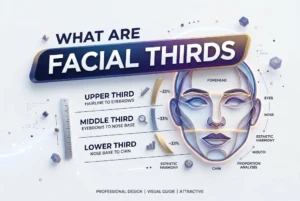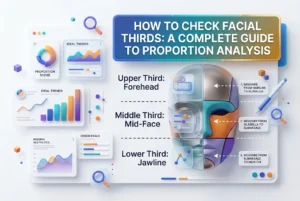
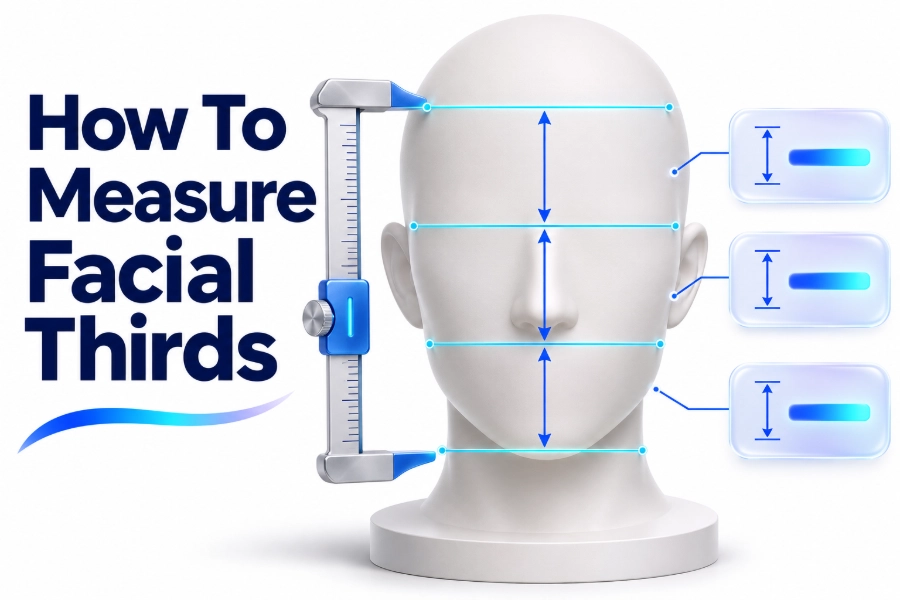
Facial thirds are a simple way to assess vertical facial proportions. The method divides the face into three horizontal sections: the upper third from the hairline to the brow area, the middle third from the brows to the base of the nose, and the lower third from the base of the nose to the bottom of the chin. Learning how to measure facial thirds can help with makeup placement, hairstyle decisions, portrait drawing, orthodontic conversations, facial analysis, and a better understanding of your own features.
The goal is not to decide whether a face is “perfect.” Real faces are naturally asymmetrical, hairlines vary, and facial proportions change with age, expression, and camera angle. Facial thirds are best treated as a visual reference rather than a rule. In this article, you will learn where to place each measurement point, how to measure accurately at home, what equal and unequal thirds may mean, and which mistakes can make your results misleading.
What Facial Thirds Measure
Facial thirds measure the vertical balance of the face. Rather than focusing on individual features in isolation, they compare the overall height of the forehead, nose-and-cheek region, and lower face. This makes the method useful when assessing how features relate to one another.
The classic facial thirds approach comes from artistic and aesthetic proportion systems. It is commonly used in portraiture and facial analysis, but it should not be mistaken for a medical diagnosis or a universal beauty standard. A harmonious face does not need three mathematically identical sections.
The three areas are usually identified using these
- Upper third: from the hairline to the glabella, the smooth area between the eyebrows
- Middle third: from the glabella to the subnasale, where the base of the nose meets the upper lip
- Lower third: from the subnasale to the menton, the lowest point of the chin
Each landmark should be found on the centerline of the face. Measuring from the side, at an angle, or while tilting your head can distort the relationship between the sections.
Why Facial Proportions Vary Naturally
Few people have perfectly equal facial thirds. Genetics, ancestry, skeletal structure, dental development, body composition, age, and soft tissue all influence facial length. A slightly longer forehead, shorter chin, or prominent nose may simply be part of someone’s normal facial character.
Hairline position is one of the biggest variables. Some people have a high, low, uneven, or receding hairline, which makes the upper third difficult to define. In those cases, it is often more useful to compare the middle and lower thirds or use an estimated original hairline instead of treating the visible hairline as fixed.
A face can also look different in photographs than it does in person. Wide-angle lenses can enlarge central features, while a camera held below the face can make the lower third appear longer. For appearance-focused analysis, use a straight-on image taken at eye level with minimal lens distortion.
Tools You Need for Accurate Measuring
You do not need specialized equipment to measure facial thirds at home. A flexible measuring tape is the easiest option, though a ruler and a clear frontal photograph can also work. Keep the process simple so you can repeat it consistently.
For the most reliable results, stand in front of a mirror with good, even lighting. Keep your face relaxed, look straight ahead, and avoid lifting or lowering your chin. If you measure from a photo, use one where the head is upright and the face is not smiling broadly.
A practical home setup includes:
1. A flexible fabric tape measure or soft ruler
2. A mirror at eye level
3. A hair clip or headband to expose the hairline
4. A phone camera for a straight-on reference photo
5. A notes app or paper to record measurements
6. Optional washable makeup pencil to lightly mark landmarks in a mirror
Avoid using a rigid ruler directly against the contours of your face. It can slip or sit unevenly, especially around the nose and chin. A soft tape follows the central facial line more comfortably.
The Main Landmarks to Find
Accurate facial thirds depend on choosing consistent landmarks. The first point is the trichion, which is the center of the hairline. If your hairline has a widow’s peak, use the general center of the natural hairline rather than the lowest point of the peak.
The second point is the glabella, located between the eyebrows and just above the bridge of the nose. The third is the subnasale, the point beneath the nose where it meets the upper lip. The final point is the menton, the lowest central point of the chin.
Finding the Hairline Point
Pull your hair away from your forehead and look for the point where dense scalp hair begins at the center. Do not include baby hairs or isolated strands. If you have a receding or irregular hairline, take note of that before comparing the upper third with the others.
Finding the Brow and Nose Landmarks
The glabella sits above the nose bridge, not at the top of the eyebrows. The subnasale is easy to identify when viewed from the front: it is the small central crease immediately under the nasal base. Both points should be measured along the facial midline.
Step-by-Step Method for Measuring Facial Thirds
Begin with a clean, makeup-free face if possible, since contouring, heavy brows, and false lashes can make landmarks harder to see. Tie back your hair and stand with your shoulders relaxed. Your eyes should look directly forward rather than down at the measuring tape.
Measure each section separately, recording the result in millimeters or centimeters. Repeat the process two or three times. If one measurement differs noticeably, reposition the tape and find the average instead of relying on a single attempt.
1. Place the start of the tape at the center hairline.
2. Measure straight down to the glabella and record the upper-third length.
3. Measure from the glabella to the subnasale and record the middle-third length.
4. Measure from the subnasale to the lowest point of the chin and record the lower-third length.
5. Compare the three numbers rather than focusing on the total facial length.
6. Repeat the measurements while maintaining the same upright posture.
For example, your results might be 6.2 cm for the upper third, 6.0 cm for the middle third, and 6.5 cm for the lower third. This would indicate a fairly balanced face with a mildly longer lower third. That difference is common and does not automatically indicate a problem.
Measuring Facial Thirds From a Photo
A photo can be easier to assess because you can draw guidelines without moving your head. Choose a front-facing image taken in portrait orientation, at approximately eye level. Keep the face centered and avoid using selfies shot from very close range.
Use a photo-editing app that allows lines, grids, or markup. Draw a vertical line down the center of the face, then add horizontal lines at the hairline, glabella, base of the nose, and chin. Compare the spacing visually or measure pixels between each line.
Photo-based measurement is especially helpful for artists and people comparing facial balance before and after a styling change. For more portrait-oriented reference, [Internal Link: facial symmetry guide] can help you evaluate horizontal balance alongside vertical proportions.
Do not compare pixel measurements from different photographs unless the camera distance and head position are similar. A single image is useful for proportion; a collection of inconsistently shot images is much less reliable.
Reading Your Results Without Overanalyzing
Equal facial thirds are often described as a classical proportion ideal, but equal does not mean better. Some of the most distinctive and attractive faces have noticeable variations between their upper, middle, and lower sections. The purpose of measurement is to observe, not judge.
A longer upper third may create the impression of a taller forehead. A longer middle third can make the nose and cheek region appear more prominent. A longer lower third may be linked visually to a longer chin, a more open bite, or simply a naturally elongated jaw area.
| Facial area | What a longer measurement may visually suggest | Common non-medical reason |
|—|—|—|
| Upper third | Taller forehead | High or naturally receded hairline |
| Middle third | More prominent central face | Nose length or facial bone structure |
| Lower third | Longer chin or jaw area | Chin shape, tooth position, jaw proportions |
| Any third | Unevenness in photos | Head tilt, expression, lens distortion |
Measurements alone cannot explain why a proportion exists. If you have concerns about your bite, jaw pain, breathing, or a significant change in facial appearance, a dentist, orthodontist, or physician is the appropriate person to consult.
Breaking Down the Lower Facial Third
The lower third is often examined more closely because it includes the lips, teeth, chin, and jaw relationship. It can be divided again into an upper portion from the base of the nose to the lip line and a lower portion from the lip line to the chin.
A traditional artistic guideline often places the upper lip-to-chin relationship at roughly one-third above the mouth and two-thirds below it. This is only a broad reference. Lip fullness, chin projection, facial expression, and ethnicity all affect how the lower face appears.
Why Tooth Position Can Affect Appearance
Teeth support the lips and contribute to the vertical dimension of the lower face. Changes such as worn teeth, bite differences, missing teeth, or orthodontic movement can influence how the jaw and lips rest. That does not mean a home measurement can identify a dental issue.
If you are considering orthodontic treatment or cosmetic procedures, bring clear questions and photos to a qualified professional. A complete assessment considers bite function, skeletal structure, soft tissue, and health, not just a facial thirds ratio.
Chin Shape and Facial Balance
A short or rounded chin can make the lower third appear smaller even when its vertical measurement is typical. A long, pointed, or prominent chin can have the opposite effect. Projection from the side profile also matters, which facial thirds do not measure.
This is why front-view proportions should be paired with common sense. A face is three-dimensional, expressive, and dynamic. One straight vertical measurement cannot capture every aspect of facial harmony.
Common Mistakes That Affect Measurements
The most frequent mistake is measuring while looking down. When you drop your chin to see the tape, the soft tissue under the chin compresses and the lower third can appear shorter. Use a mirror or ask someone to help if holding the tape changes your posture.
Another common issue is measuring to the eyebrows rather than the glabella. Eyebrow height varies with grooming, makeup, and facial expression, while the glabella is a more stable reference point. Raised brows can make the upper third seem artificially longer.
Keep these practical checks in mind:
- Do keep your head level and eyes facing forward.
- Do measure along the centerline, not along the side of the nose.
- Do repeat the measurement before drawing conclusions.
- Do use a neutral facial expression.
- Do not rely on a close-up selfie from below eye level.
- Do not measure to the tip of the nose instead of its base.
- Do not assume unequal thirds mean something is wrong.
- Do not compare your results directly with edited celebrity images.
Using Facial Thirds for Makeup and Styling
Facial thirds can be useful when choosing visual balance techniques, especially in makeup, hair, glasses, and portrait photography. These choices do not “correct” a face; they can simply emphasize features you already like or create a different visual impression.
For a longer upper third, fringe styles, side-swept bangs, or added brow definition can bring more attention to the center of the face. For a longer lower third, blush placement slightly higher on the cheeks and lip color can draw focus upward. These are creative choices, not mandatory rules.
Hair styling also changes perceived proportion. Volume at the crown can make the upper third seem longer, while face-framing layers can reduce the visual emphasis of a high forehead. If you are testing styles, take photos in the same lighting and angle so you can compare fairly.
Makeup placement works best when it follows your facial structure rather than chasing a diagram. [Internal Link: face shape makeup techniques] can offer complementary ideas for blush, contour, and highlight placement based on the overall outline of the face.
Facial Thirds for Artists and Photographers
For artists, facial thirds are a helpful construction tool. Start with the full head shape, then place the brow line around the middle of the head rather than halfway down the visible face. From there, map the nose base and chin using proportional guides.
The hairline is especially important in drawing because it helps establish age, hairstyle, and character. A high hairline can make a figure look older or more intellectual; a low hairline may make the forehead feel smaller. These are visual signals, not fixed personality traits.
Photographers can use facial thirds when posing subjects. Raising or lowering the camera changes the apparent balance of the face, while chin direction affects the visibility of the jaw and neck. A camera at eye height with a moderate focal length usually produces a more natural reference image.
When editing portraits, avoid reshaping features simply to force equal thirds. Retouching that preserves the subject’s identity generally looks more convincing than aggressively chasing a proportion formula.
When Professional Assessment Makes Sense
Measuring facial thirds at home is appropriate for curiosity, aesthetics, makeup, or artistic reference. It is not enough to assess orthodontic treatment needs, jaw disorders, facial growth concerns, or reconstructive options. Those situations require clinical examination and often X-rays or scans.
Consider professional advice if you have persistent jaw pain, difficulty chewing, an open bite, frequent headaches associated with clenching, breathing concerns, or a noticeable change in your facial proportions over time. These symptoms deserve attention because function matters more than appearance.
A qualified orthodontist, oral and maxillofacial surgeon, dentist, dermatologist, or facial plastic surgeon may use facial proportions as one small part of an assessment. They should also discuss your goals, health history, tissue quality, bite, and realistic outcomes.
Be wary of anyone who promises to diagnose a structural condition from one selfie or says a single ratio proves you need treatment. Responsible facial analysis is individualized and considers far more than a ruler measurement.
Conclusion
Learning how to measure facial thirds gives you a practical framework for observing vertical facial balance. Start with clear landmarks: the central hairline, glabella, base of the nose, and lowest point of the chin. Measure with your head upright, repeat the process, and use a straight-on photo if you want an easy visual reference.
The most important takeaway is that facial thirds are descriptive, not prescriptive. A small difference between sections is normal, and even larger variation may reflect nothing more than a unique hairline, chin shape, or family trait. Use your results to guide makeup placement, drawing, photography, or a thoughtful conversation with a professional when needed.
Avoid treating a proportion chart as a verdict on your appearance. Faces are not designed to fit a single template, and balance often comes from the way features work together rather than from exact numerical equality. A careful measurement can be informative, but confidence and facial character cannot be reduced to three numbers.
Frequently Asked Questions
What are the three facial thirds?
The three facial thirds are the upper third from hairline to glabella, middle third from glabella to the nose base, and lower third from nose base to chin. They are used to compare vertical facial proportions.
Should facial thirds be equal?
No, facial thirds do not need to be equal. Equal sections are a traditional artistic reference, but natural variation is common. Hairline shape, chin structure, and facial growth can all create noticeable yet normal differences.
Can I measure facial thirds with a selfie?
You can, but use caution. A close selfie may distort the nose and central face because of lens perspective. Use a straight-on photo taken farther away, at eye level, for a more dependable comparison.
Where does the middle facial third start?
The middle facial third starts at the glabella, the smooth point between the eyebrows above the nose bridge. It ends at the subnasale, where the base of the nose meets the upper lip.
Can facial thirds diagnose jaw problems?
No, facial thirds cannot diagnose jaw or bite problems. They show visible proportions only. If you have pain, chewing difficulty, bite concerns, or breathing issues, seek an assessment from a qualified dental or medical professional.