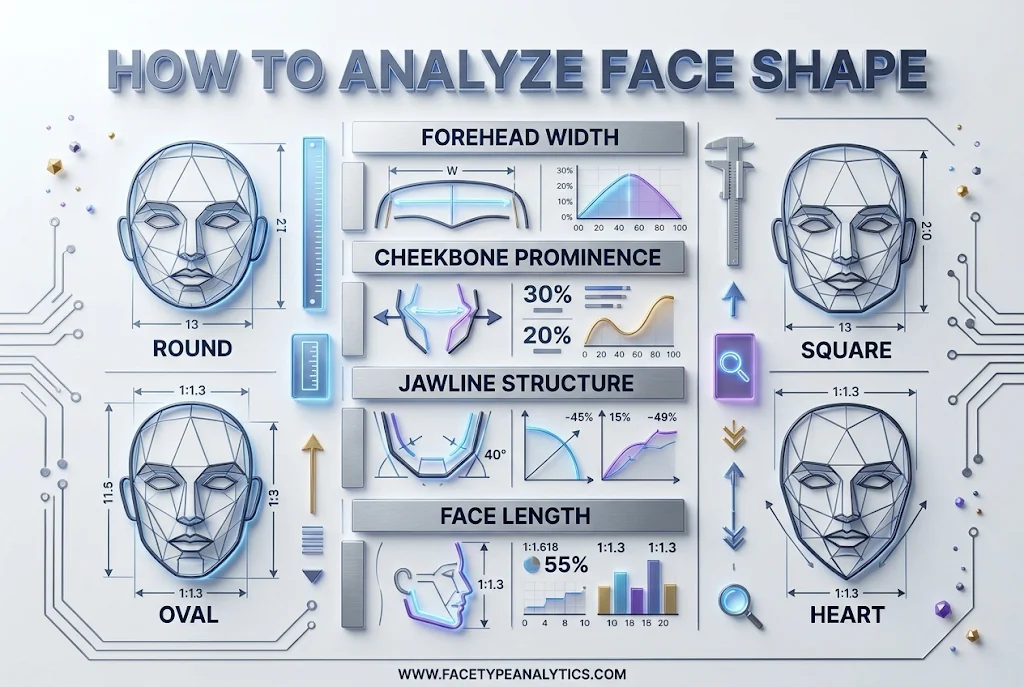
Your face shape is not a fixed label you need to get “right.” It is simply a useful way to describe the proportions of your forehead, cheekbones, jawline, and face length. Learning how to analyze face shape can make choices such as hairstyles, glasses, makeup placement, beard styles, and earrings feel more intentional. The best approach is to look at several features together rather than relying on one selfie, one measurement, or an online filter.
Most people do not fit perfectly into a single category. You may have an oval face with a softly square jaw, or a heart-shaped face with a longer overall length. That is normal. The goal is to identify the features that stand out most, then use that information as a flexible styling reference. This article explains how to assess your face accurately at home, compare common face shapes, avoid misleading methods, and use your results in practical ways.
What Face Shape Analysis Actually Measures
Face shape analysis compares the horizontal width and vertical length of your face. It also considers where your face is widest, how your jawline tapers, and whether your chin is rounded, pointed, broad, or prominent. These features create the overall outline associated with familiar face-shape categories.
The categories are descriptive, not medical or scientific diagnoses. Bone structure, facial fullness, age, hairline, and even camera angle can affect the appearance of your face. Treat the result as a helpful starting point, especially when choosing styles, rather than a rule that limits what you can wear.
Prepare for an Accurate Assessment
Start with a clear, front-facing view of your face. Pull your hair away from your forehead and jawline, remove large glasses, and use soft, even lighting. Stand facing a mirror or ask someone to take a photo at eye level from a short distance away.
Avoid analyzing your face through a close-up phone selfie. Wide-angle lenses can enlarge the center of the face and make your cheeks or nose appear broader than they are. A rear-camera photo taken at eye level, or a simple mirror assessment, usually gives a more balanced view.
Practical setup checklist
- Tie back hair, including bangs that hide the hairline.
- Keep your expression relaxed and your jaw unclenched.
- Use daylight near a window or evenly diffused indoor light.
- Hold the camera level with the center of your face.
- Compare a mirror view with one straight-on photograph.
- Repeat the check on another day if lighting or swelling affects your features.
Measure the Key Areas of Your Face
You do not need specialized equipment. A flexible tape measure is useful, but a ruler and a photo can also work. Measure lightly and record approximate numbers; tiny differences rarely change the overall result.
Focus on four areas: forehead width, cheekbone width, jawline width, and face length. The relationship between these measurements matters more than precision to the millimeter. For example, cheekbones that are clearly wider than both forehead and jaw are more informative than a one-centimeter variation.
Forehead Width
Measure across the broadest part of your forehead, usually halfway between your eyebrows and hairline. Some people have a widow’s peak or an uneven hairline, so follow the widest natural line rather than trying to measure the hairline itself.
Cheekbone Width
Place the tape measure across the widest points of your cheekbones, generally just below the outer corners of your eyes. This measurement is often the most useful for distinguishing diamond, heart, and round facial proportions.
Jawline Width
Measure from the tip of your chin to the point below one ear where the jaw turns upward. Double that number for an approximate full jaw width. Also notice the jaw’s appearance: angular, curved, narrow, or broad.
Face Length
Measure from the center of your hairline to the bottom of your chin. A longer face does not automatically mean an oblong shape; it must be considered alongside forehead, cheekbone, and jaw proportions.
Read Your Overall Outline Before Choosing a Category
After measuring, step back and look at the silhouette of your face. Ask where it appears widest and how the width changes from forehead to cheeks to jaw. Notice whether the sides look straight, curved, or tapered.
Your chin and jawline often provide the clearest clues. A gently rounded chin can point toward oval or round proportions, while a strong jaw with similar forehead width often suggests square proportions. A narrow, pointed chin may indicate heart or diamond characteristics.
Quick measurement guide
1. Compare face length with cheekbone width. A noticeably longer face may be oval, oblong, heart, or diamond rather than round or square.
2. Compare forehead and jaw widths. Similar widths create a more balanced or angular outline, while a much wider forehead and narrow jaw create a tapered outline.
3. Identify the widest point. Cheekbones are often widest in diamond and round faces; the forehead is often widest in heart-shaped faces.
4. Assess the jawline separately. A soft, curved jaw changes the impression of a face even when measurements are similar.
5. Choose the closest pattern, then note secondary traits. “Oval with a defined jaw” is often more useful than forcing a single label.
Oval Face Shape Characteristics
An oval face is usually longer than it is wide, with cheekbones slightly wider than the forehead and jaw. The jawline is softly rounded, and the chin is not dramatically pointed or square. The overall outline tends to narrow gradually toward the chin.
Oval is often described as balanced because no single area dominates the face. That does not mean every person with an oval face looks alike. Some oval faces have a high forehead, fuller cheeks, a stronger jaw, or a more tapered chin.
Common Styling Considerations
Many haircut lengths and eyeglass shapes can work well with oval proportions. The main goal is usually to preserve balance rather than add width or length in one area. Extremely heavy volume on top may make an already long face appear longer.
For makeup, blush can sit naturally along the upper cheeks, while contour is optional rather than necessary for reshaping. If you are selecting frames, choose a size that matches your facial width instead of choosing oversized glasses solely because oval faces are considered versatile.
Round Face Shape Characteristics
A round face typically has a similar face length and cheekbone width, with full cheeks and a curved jawline. The forehead and jaw are often narrower than the cheeks, while the chin appears short and rounded rather than pointed.
Round does not mean a face has to be full or youthful-looking. A person can have a lean face and still have round proportions because the defining feature is the soft, equal-width outline. Looking only at cheek fullness can lead to an inaccurate classification.
Square Face Shape Characteristics
A square face generally has a forehead, cheekbone area, and jaw that appear close in width. The sides of the face may look relatively straight, and the jawline is strong, broad, or visibly angular. Face length can be similar to width or slightly longer.
The key distinction from a round face is structure. Round faces have softer curves, while square faces have clearer corners around the temples and jaw. Some people fall between these patterns and may describe themselves as having a soft square face.
Comparison points for round and square faces
- Round faces usually show curved cheeks and a softer chin.
- Square faces usually show a more defined jaw and straighter side lines.
- Both can have similar length-to-width proportions.
- Facial fullness can change over time, but underlying jaw structure remains a useful clue.
- Hairstyles that add height can lengthen either shape, while wide side volume can emphasize width.
Heart Face Shape Characteristics
A heart-shaped face is often widest at the forehead or upper cheekbones and narrows toward a smaller chin. The hairline may form a widow’s peak, but this is not required. The lower half of the face usually looks more delicate or tapered than the upper half.
This shape is sometimes confused with an inverted triangle. In everyday styling advice, the terms are frequently used interchangeably, though “heart” often implies a softer chin and more curved outline. The practical focus is the same: balance a wider upper face with a narrower jaw.
Useful Signs to Look For
Look at your face with your hair pulled back. If your forehead feels noticeably broader than your jaw and your chin comes to a gentle point, heart-shaped proportions may be the closest match. Cheekbones can be prominent, but they are not always the widest point.
When choosing a haircut or accessories, visual weight near the jaw can create balance. Chin-length layers, lower-volume styles, and frames that are slightly wider toward the bottom are common options. For more ideas, see [Internal Link: Best Hairstyles for Heart-Shaped Faces].
Diamond Face Shape Characteristics
A diamond face is usually widest at the cheekbones, with a narrower forehead and jawline. The chin often appears pointed, and the forehead may be relatively short or narrow. This creates a more angular outline than a heart-shaped face.
The difference between diamond and heart shapes comes down to the forehead. Heart faces are typically broadest at the forehead, while diamond faces are broadest at the cheekbones. Looking at a front-facing photo can make this comparison easier than relying on memory.
Oblong and Rectangle Face Shape Characteristics
Oblong and rectangle faces are longer than they are wide. The forehead, cheekbones, and jaw may be relatively similar in width, but the vertical length is the feature that stands out most. The jawline can be rounded in an oblong face or more angular in a rectangle face.
These terms are useful because face length affects styling choices. Very long, straight hairstyles or narrow, shallow eyeglass frames may emphasize vertical length. Side volume, layered cuts, or frames with more depth can create a more balanced visual effect.
Common analysis mistakes
- Calling a face oval solely because it is longer than it is wide.
- Judging face shape from a tilted, close-up selfie.
- Ignoring the hairline because bangs or curls hide it.
- Confusing facial fullness with bone structure.
- Assuming one category must fit perfectly.
- Using a beauty filter, which may slim the jaw or alter facial proportions.
- Measuring one side of an asymmetrical face and treating it as exact.
Use Photos and Apps With Care
Face-shape apps can be entertaining and may offer a quick starting point, but they should not be treated as definitive. Many tools depend on face-detection points that are affected by lighting, expression, makeup, hair, lens distortion, and the quality of the uploaded photo.
A better method is to combine an app result with your own observation. If an app identifies a heart shape but your cheekbones are clearly wider than your forehead, compare diamond characteristics as well. Your direct measurements and mirror assessment are usually more valuable than an automated label.
A Simple Photo Method
Take a straight-on photo with your hair pulled back and trace the visible outline of your face on a duplicate image. You can do this digitally or by placing transparent paper over a printed photo. The traced shape makes broad versus narrow areas easier to see.
Do not trace your hairstyle, ears, or contour makeup. Follow the forehead, cheeks, jaw, and chin. Review the result beside the original photograph so you do not mistake shadow or an uneven pose for actual facial structure.
Work With Mixed Face Shape Features
Many people have blended features, and that is often the most accurate result. You might have oval length, heart-shaped tapering, and a square jaw. Instead of searching for a perfect category, identify the two or three features that affect your styling decisions.
This approach is especially helpful when choosing haircuts or glasses. If your face is long with a broad jaw, consider both length and jaw structure. If it is rounded with a narrow chin, styles that add height may work differently than styles designed for a classic round face.
Practical examples
- An oval face with a broad forehead may benefit from face-framing layers or a fringe, even though oval faces are often called versatile.
- A soft square face may prefer rounded eyeglass frames to contrast with the jaw, while still choosing a frame wide enough for the face.
- A heart-shaped face with high cheekbones may find that cheekbone width, not only forehead width, matters when selecting sunglasses.
- A diamond face with a rounded chin may suit some heart-face styling advice more than sharply angular diamond-face recommendations.
- A long face with soft curves may be better described as oblong than rectangular.
Apply Your Result to Styling Choices
Face shape is most useful when it helps you make a specific choice. For hairstyles, decide whether you want to add width, reduce visual length, soften angles, or show off a feature you like. There is no need to “correct” your shape; styling is about preference and proportion.
For glasses, use face shape as one factor alongside fit, bridge comfort, prescription needs, and personal style. Frame width should generally align with your face width, while shape can add contrast or echo your natural lines. A qualified optician can help with fit concerns that face-shape advice cannot solve.
Makeup and Grooming Considerations
Makeup placement can emphasize different areas without changing your actual face shape. Blush placed higher and outward can draw attention to cheekbones, while contour can add temporary definition around the forehead, cheeks, or jaw. Start lightly and evaluate in natural light.
For facial hair, beard shape can alter the visual balance of the lower face. A fuller beard may add width to a narrow jaw, while a shorter, more structured style can highlight a strong jawline. [Internal Link: Beard Styles by Face Shape] can help you compare options without treating any style as mandatory.
When Face Shape Changes or Feels Unclear
Your underlying bone structure changes slowly after adulthood, but your face can look different because of weight changes, aging, hormones, dental work, swelling, hairstyle, or facial hair. This is why a result that seemed obvious years ago may feel less clear now.
If your measurements sit between categories, use your practical goal to guide your choice. For instance, someone with an oval-square blend who wants softer-looking glasses can prioritize rounded frames. A person seeking a sharper effect can choose more angular shapes instead.
Conclusion
The most reliable way to assess your face is to combine a straight-on view, approximate measurements, and an honest look at your forehead, cheekbones, jawline, and chin. Focus on proportions rather than trying to match a diagram perfectly. Oval, round, square, heart, diamond, and oblong labels are useful shorthand, but mixed traits are common and often more descriptive.
When you know how to analyze face shape, use the result as a styling tool rather than a restriction. It can help you compare haircut shapes, choose glasses that fit your features, place makeup with more intention, or refine a beard style. Recheck your assessment in neutral lighting and from more than one photo if you are unsure. The best final answer is the category, or combination of categories, that consistently reflects your natural outline and supports the choices you want to make.
Frequently Asked Questions
Can I have more than one face shape?
Yes. Most people have blended traits, such as oval length with a square jaw or heart-shaped tapering with prominent cheekbones. Choose the dominant pattern, then note secondary traits when making styling decisions.
Is face shape based on weight?
Not entirely. Weight can change cheek fullness and jaw definition, but forehead width, cheekbone placement, jaw structure, and face length remain important. Assess both your outline and your underlying proportions for a clearer result.
Are face shape apps accurate?
They can provide a useful starting point, but they are not consistently accurate. Camera angles, filters, hair, lighting, and facial expression can affect results. Compare an app’s suggestion with mirror observations and simple measurements.
What is the easiest way to measure face shape?
Use a flexible tape measure to compare forehead width, cheekbone width, jaw width, and face length. Then assess your jawline and chin visually. Approximate comparisons matter more than perfectly precise numbers.
Does a haircut change face shape?
A haircut does not change bone structure, but it can change how proportions appear. Volume, fringe, layers, length, and face-framing pieces can emphasize width, soften angles, or create the impression of more balance.