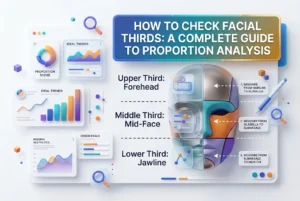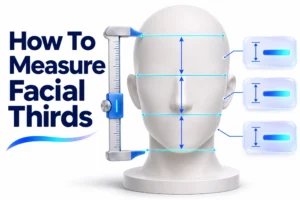
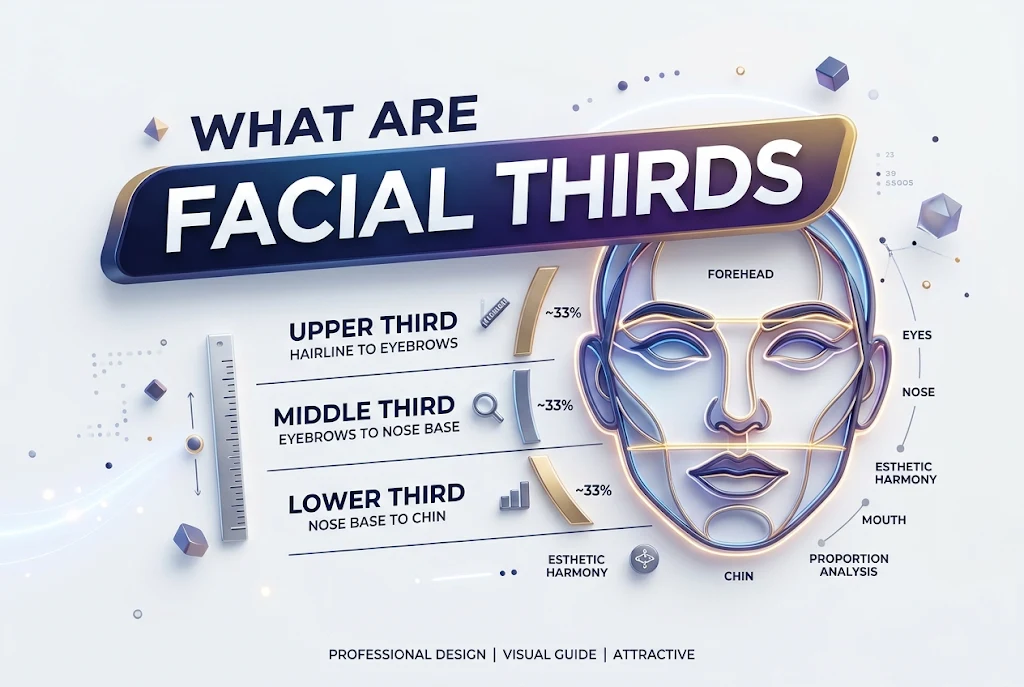
Facial thirds are a simple way to assess the vertical proportions of the face. If you have seen a makeup artist, orthodontist, injector, or facial plastic surgeon refer to “balanced proportions,” they may be using this concept. So, what are facial thirds exactly? The face is divided horizontally into three sections: from the hairline to the brows, from the brows to the base of the nose, and from the base of the nose to the chin. In an ideally proportioned face, these sections appear relatively similar in height.
That idea is useful, but it is not a beauty rule or a diagnosis. Natural facial variation is normal, and proportion matters more than mathematical perfection. Facial thirds can help explain why a hairstyle, brow shape, dental change, or cosmetic treatment affects overall balance. They are also used in orthodontics and facial analysis to plan care thoughtfully. This article explains the three facial thirds, how professionals assess them, what can alter their appearance, and why symmetry is only one part of an attractive, healthy-looking face.
The Three Vertical Sections of the Face
The facial thirds model divides the face into upper, middle, and lower zones. The traditional landmarks are the hairline, the point between the eyebrows, the base of the nose, and the lowest point of the chin. These landmarks create a practical visual framework rather than an exact universal measurement.
A face does not need three identical sections to look balanced. Genetics, ethnicity, age, sex, soft-tissue thickness, dental structure, and hairstyle all affect visible proportions. The goal is to identify relationships between features, not to label a face as good or bad based on a ratio.
Upper Facial Third
The upper third runs from the hairline to the glabella, the smooth area between the eyebrows just above the nose. It includes the forehead and brow region. A high hairline, receding hairline, broad forehead, or certain hairstyles can make this area appear longer.
Forehead height has a large visual effect because it frames the eyes and brows. In aesthetic assessments, practitioners consider brow position, forehead contour, hair density, and hairline shape together. Measuring only the forehead can be misleading when the hairline has changed over time.
Middle Facial Third
The middle third extends from the glabella to the subnasale, where the base of the nose meets the upper lip. It includes the eyes, cheeks, nose, and upper cheekbone area. This zone often receives attention in discussions of midface volume and facial aging.
A longer or flatter-looking midface may result from bone structure, cheek projection, nose length, under-eye hollowing, or volume loss. Lighting and camera angles can exaggerate these features, which is why in-person assessment is more reliable than judging proportions from a single selfie.
Lower Facial Third
The lower third runs from the base of the nose to the bottom of the chin. It includes the lips, teeth, jawline, and chin. Orthodontists and dentists often examine this region because tooth position, bite alignment, and jaw development can influence its apparent height.
The lower third is sometimes divided again into an upper portion, from the base of the nose to the lip line, and a lower portion, from the lip line to the chin. Lip fullness, chin projection, tooth display, and jaw position all contribute to how this section appears.
Why Facial Thirds Matter in Facial Analysis
Facial thirds give professionals a shared language for discussing proportion. A dentist may use them when evaluating facial height and bite changes, while an injector may use them when considering cheek or chin balance. They help connect individual features to the face as a whole.
They are especially helpful when someone notices a concern but cannot identify its source. For example, a person may think their nose looks large when a recessed chin or low cheek projection is creating contrast. Looking at the entire facial structure can prevent overly narrow treatment decisions.
Facial thirds should never be treated as a checklist for attractiveness. Faces with uneven thirds can be striking, memorable, and naturally harmonious. A thoughtful assessment also considers facial width, profile, skin quality, expression, ethnicity, and the person’s own aesthetic preferences.
- They create context: A feature is assessed in relation to nearby structures, not in isolation.
- They support treatment planning: Dental, orthodontic, surgical, and cosmetic choices can affect facial balance.
- They help track change: Aging, weight fluctuations, hair loss, and dental work may alter perceived proportions.
- They have limits: Standard ratios cannot account for every face, culture, or personal preference.
How Professionals Measure Facial Thirds
A professional usually begins with a relaxed, forward-facing view of the face. The head should be in a natural position, with the eyes looking straight ahead and the teeth gently together. Standardized photographs or clinical measurements make the comparison more consistent.
The main landmarks are then identified: the trichion at the hairline, glabella between the brows, subnasale beneath the nose, and menton at the lowest point of the chin. Distances between these points are compared, usually as proportions rather than isolated millimeter numbers.
Hairline position requires extra care. A naturally high forehead, thinning hair, a widow’s peak, or styling choices can make the trichion difficult to locate. Some clinicians use additional landmarks and compare multiple views instead of relying on one front-facing measurement.
Static Measurements Versus Facial Movement
A still photo cannot show how the face works in everyday life. Lip movement, smile width, tooth display, speech, and muscle activity may reveal more than a static proportion assessment. This is particularly important in dentistry, orthodontics, and facial aesthetics.
For instance, a lower third may seem long at rest but look well balanced when the person smiles. Conversely, reduced tooth support can make the lower face appear shorter or more collapsed over time. Functional evaluation helps separate structural concerns from photographic impressions.
Why Professional Photography Helps
Standard clinical photography uses consistent lighting, distance, posture, and lens choice. This reduces the distortion that can happen with phone cameras, especially wide-angle front cameras. Small changes in camera position can make the nose, forehead, or chin look noticeably different.
A consultation may include frontal, profile, and three-quarter views. These perspectives reveal whether an apparent imbalance is truly vertical or is related to projection, asymmetry, posture, or facial width. [Internal Link: Facial Symmetry and Proportion] can provide useful context when comparing these related concepts.
Facial Thirds and the Golden Ratio
Facial thirds are often linked to the golden ratio, but the two ideas are not the same. The golden ratio is a mathematical proportion often cited in art, design, and facial aesthetics. Facial thirds are a basic vertical segmentation method used for observation and planning.
Some facial features may approximate certain ratios, yet there is no universal formula that defines beauty. Studies and clinical experience both show that attractiveness is influenced by many factors, including skin health, expression, sexual dimorphism, cultural expectations, and feature harmony.
The most useful takeaway is that proportion is relational. A forehead can be taller than average and still suit the face beautifully. A shorter chin may look balanced with softer features, while a more projected chin may complement a stronger nose or jawline.
| Facial assessment concept | What it evaluates | Best use |
|—|—|—|
| Facial thirds | Vertical height of upper, middle, and lower face | Broad proportion review |
| Facial fifths | Horizontal width across the face | Eye spacing and facial width |
| Symmetry | Similarity between left and right sides | Identifying asymmetry |
| Profile analysis | Forehead, nose, lips, and chin projection | Side-view balance |
| Golden ratio | Mathematical relationship between dimensions | Artistic reference, not a rule |
Common Reasons Facial Thirds Look Uneven
Visible imbalance can be structural, temporary, or purely perceptual. Bone shape and jaw development influence the face from childhood onward, while aging changes soft tissue volume and skin elasticity. A single cause should not be assumed without a full assessment.
The upper third may look longer because of hairline recession, a naturally high forehead, or brow position. The middle third may appear longer due to a longer nose, flatter cheeks, or under-eye volume loss. The lower third can be affected by jaw position, tooth wear, chin shape, and lip support.
Dental and Jaw Factors
An overbite, underbite, open bite, or missing teeth can alter the lower facial third. Changes in tooth height and jaw relationship may affect lip posture, chin appearance, and the amount of facial height visible when the mouth is at rest.
Orthodontic or restorative dental treatment can sometimes improve functional concerns and alter facial support. The outcome depends on the individual’s anatomy and treatment plan. Cosmetic changes should never take priority over a healthy bite, joint function, or stable dental result.
Aging and Soft-Tissue Changes
As the face ages, the upper third may seem larger because of hairline changes and brow descent. In the middle third, cheek volume can shift downward and under-eye hollows can become more visible. These changes alter light and shadow across the face.
The lower third may appear shorter or less supported when teeth wear down, lips lose volume, or the jawline softens. A projected chin can also seem less defined as skin and soft tissue change. These are common age-related changes, not signs that anything is wrong.
Ways to Assess Your Own Facial Proportions
You can use facial thirds as a casual observation tool, but home measurements should be treated cautiously. A mirror or photo may help you notice broad patterns, yet neither can replace a clinical assessment when you are considering orthodontic, dental, or cosmetic treatment.
Start with a straight-on image taken at eye level, preferably with the camera farther away and slightly zoomed in. Keep your head neutral, relax your face, and avoid tilting your chin. Compare the zones rather than trying to force an exact equal measurement.
1. Identify the visible hairline, brow area, base of the nose, and lowest point of the chin.
2. Divide the face into upper, middle, and lower horizontal sections.
3. Look for a clear difference in apparent height, not tiny variations.
4. Compare a front-facing image with a natural profile view.
5. Consider factors such as hairstyle, expression, camera lens, and posture before drawing conclusions.
6. Speak with an appropriate qualified professional if the concern involves bite function, breathing, pain, or a planned treatment.
Treatment Options Related to Facial Balance
The right approach depends entirely on the cause of the concern. A hairstyle may soften the appearance of a longer upper third, while orthodontic treatment may be appropriate for a bite-related lower-third issue. These are very different situations and should not be approached the same way.
A qualified clinician should assess facial proportions alongside health, function, and your goals. Good treatment planning avoids chasing a generic ideal. It considers what will look natural on your face and what can be achieved safely with predictable results.
Nonmedical Styling Options
Haircuts, fringe styles, brow shaping, glasses, and makeup can change visual emphasis without altering facial anatomy. For example, a fringe can visually shorten a taller forehead, while cheek placement in makeup can create more lift through the middle third.
These options are useful when the goal is simply to experiment with balance. They are also a good first step before considering a procedure. A change that feels dramatic in a mirror may be subtle to others, so photographs in varied lighting can help set realistic expectations.
Dental and Orthodontic Care
Dentists and orthodontists may evaluate facial thirds when examining vertical facial dimension, bite alignment, tooth wear, and lip support. Treatment may include orthodontics, restorative work, or replacement of missing teeth, depending on the underlying condition.
Not every proportion difference requires treatment. Care is most relevant when there are functional symptoms, such as chewing difficulty, jaw discomfort, excessive wear, unstable bite, or speech concerns. [Internal Link: Signs You May Need Orthodontic Treatment] fits naturally into this part of the decision process.
Cosmetic and Surgical Considerations
Cosmetic approaches can include hair restoration, injectable treatments, chin enhancement, or procedures affecting the nose, jaw, or forehead. Each option has different benefits, risks, recovery requirements, and limits. A facial proportion chart alone is not enough to determine suitability.
Anyone considering a procedure should consult a licensed, experienced provider who evaluates the entire face. Ask to discuss alternatives, expected longevity, potential complications, and what happens if results are not as anticipated. Avoid providers who promise a perfect ratio or a universally ideal face.
Common Mistakes When Comparing Facial Thirds
The most common mistake is treating equal thirds as a mandatory standard. Human faces are not identical architectural drawings, and small differences are ordinary. Attempting to correct every variation can produce results that feel unnatural or disconnected from the rest of the face.
Another frequent issue is relying on distorted images. Selfie cameras, filters, low-angle photos, and harsh overhead lighting can change apparent proportions. It is also easy to focus on one concern after repeated mirror checking, even when others would not notice it.
- Do not compare your face with heavily edited social media images.
- Do not assume a long-looking middle third means your nose is the problem.
- Do not use one photo to make decisions about treatment.
- Do not ignore dental, breathing, or jaw symptoms in favor of appearance alone.
- Do seek a second opinion for permanent or invasive procedures.
- Do remember that facial character often comes from the same variations people are tempted to erase.
Facial Thirds in Different Face Types and Backgrounds
Facial analysis must account for diversity. Average measurements vary among populations, and features that are harmonious within one ethnic or family background may not match generalized charts. A responsible provider uses proportional analysis as one input, not as a standard that overrides identity.
Sex-related traits can also influence assessment. For example, brow prominence, jaw width, chin shape, lip fullness, and forehead contour may be interpreted differently depending on the person’s natural features and aesthetic goals. There is no single correct endpoint for facial balance.
Age matters as well. Children and adolescents are still growing, so their facial proportions change over time. Adults may experience alterations from aging, tooth loss, weight changes, or medical conditions. Any meaningful evaluation should be age-appropriate and clinically grounded.
When to Seek Professional Advice
A cosmetic concern alone may justify a consultation if it is persistent and you are considering a treatment. Choose a provider whose training matches the concern: a dentist or orthodontist for bite-related issues, a dermatologist for skin concerns, or a board-certified specialist for surgical or injectable options.
Prompt professional evaluation is more important when perceived proportion changes happen suddenly or accompany pain, trauma, difficulty chewing, breathing changes, facial weakness, or jaw locking. These symptoms require medical or dental assessment rather than cosmetic self-correction.
Bring clear goals to a consultation. Instead of saying you want “perfect thirds,” explain what you notice and when it bothers you. For example, you might say that your profile feels unbalanced, your bite has changed, or your forehead appears larger after hair loss. Specific observations lead to better conversations.
Conclusion
Facial thirds offer a straightforward way to look at vertical facial proportion: the forehead and brow area, the midface, and the lower face. They can be useful in dental planning, orthodontics, cosmetic consultations, and personal styling because they encourage a whole-face view rather than fixation on one feature.
The key is to use the concept with perspective. Uneven proportions are common, and attractive faces rarely follow a perfect formula. Hairline position, bone structure, bite alignment, facial volume, lighting, and posture can all affect what you see. A carefully taken photo may be informative, but it cannot explain the cause of a concern on its own.
If you are asking what are facial thirds because you are considering a change, begin by identifying whether your goal is stylistic, functional, or cosmetic. Start with the least invasive option that fits your needs, and seek qualified advice for concerns involving your teeth, jaw, health, or a permanent procedure. Balanced results come from respecting your individual features, not copying a measurement chart.
Frequently Asked Questions
Are facial thirds supposed to be equal?
Not exactly. The three sections are often compared for relative balance, but perfectly equal measurements are uncommon. Genetics, hairline shape, facial structure, and aging create natural variation that can still look harmonious.
What causes a long lower facial third?
A long lower third may reflect jaw structure, tooth position, an open bite, chin shape, or facial growth patterns. It can also be a visual impression caused by lip volume, camera angles, or posture.
Can orthodontics change facial thirds?
Orthodontics can influence lower-face appearance when it changes bite alignment, tooth position, or dental support. The degree of visible change varies widely, and treatment should primarily address function, health, and stable occlusion.
Does a high forehead mean facial proportions are unbalanced?
No. A high forehead may simply be a normal inherited feature. Hairline position, brow shape, and hairstyle strongly affect its appearance, so a taller upper third does not automatically indicate an imbalance.
Can makeup improve facial proportion appearance?
Yes. Makeup can alter visual emphasis through brow placement, contour, blush, highlight, and lip definition. It does not change bone structure, but it can create a temporary impression of greater balance in photographs and everyday settings.